
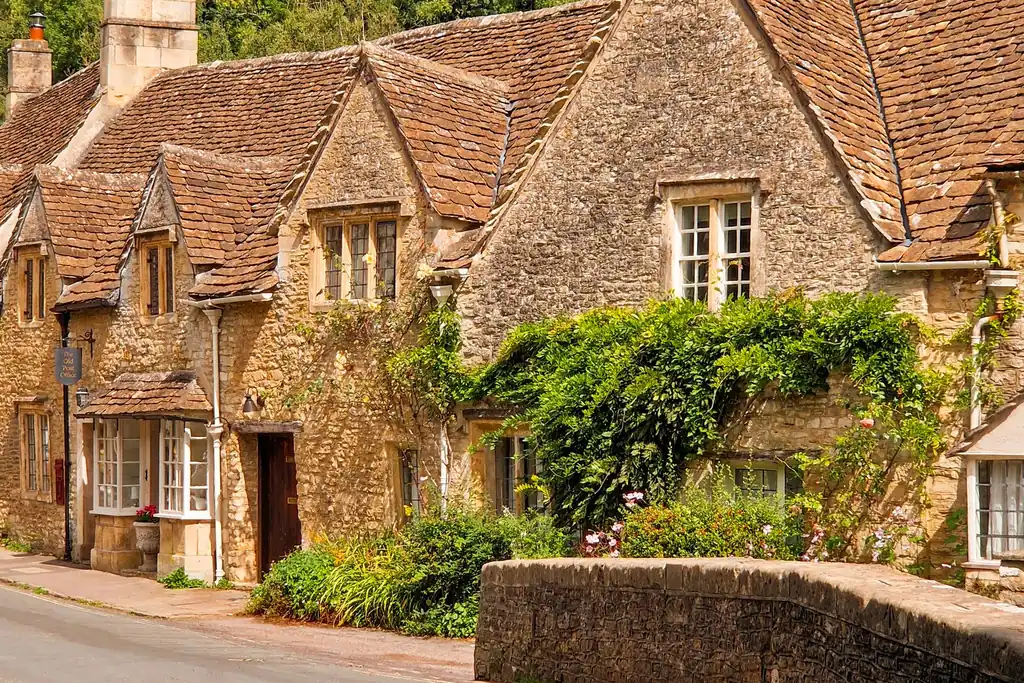
Castle Combe is a small stone village in Wiltshire, at the southern tip of the Cotswolds. It is 101 miles west of London, about 2 hours by car, and 6 miles from Chippenham station. Its medieval market cross, St Andrew’s Church with a faceless clock and the bridge over the By Brook take 45 to 90 minutes on foot.
Castle Combe at a glance
Where: north-west Wiltshire, inside the southern end of the Cotswolds
From London: 101 miles, about 2 hours 4 minutes by car on a weekday morning
By train: London Paddington to Chippenham, then 15 minutes by taxi
Time needed: 45 to 90 minutes for the village; longer with a walk in the valley
Entry: free; it is a lived-in village, and visitors use a pay-and-display car park
This guide covers what to see, how long to stay, how to get there from London, where to park, and which places pair well with it on the same day.
Where is Castle Combe?
Castle Combe is in north-west Wiltshire, 6 miles by road from Chippenham and 15 miles from Bath. It sits in a wooded valley cut by a small river, the By Brook, which flows south through the village.
- In the Cotswolds: yes, inside the official boundary at its far southern end. Most of the area lies further north, in Gloucestershire and Oxfordshire.
- Near the Cotswold Way: the long-distance trail ends in Bath, a short way south.
- From the northern villages: Bibury is 56 minutes north-east by car and Burford 1 hour 9 minutes.
Because it is so far south, the village is closer to Bath and Lacock than to Bourton-on-the-Water. Our map of the Cotswolds shows where it falls against the rest of the hills.
Why is Castle Combe famous?
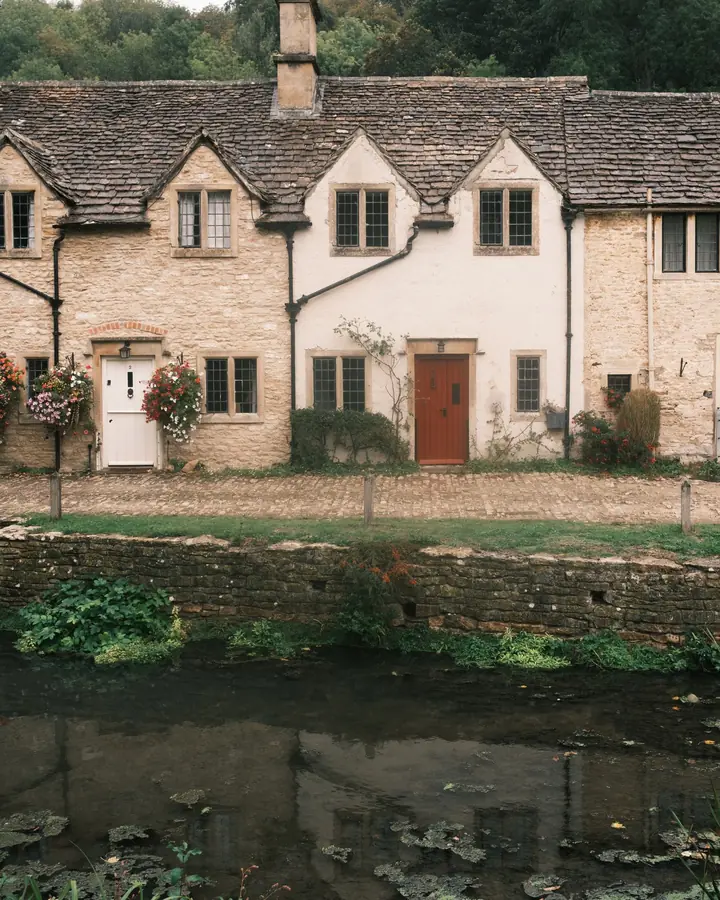
Castle Combe is famous for looking much as it did centuries ago, and it was voted the prettiest village in England in 1962. Visit Wiltshire says it has changed very little over the centuries.
- The cloth trade: in the Middle Ages the By Brook drove fulling mills, and the village grew rich on woollen cloth.
- Films: Doctor Dolittle was filmed in and around the village in 1966, for its 1967 release. Stardust, The Wolf Man and War Horse followed, and the television drama Doctor Thorne in 2016.
- Size: only about 50 people live in the village centre.
Visit Wiltshire reminds visitors that it is a living village, not a film set. The houses are private homes, so photographs are taken from the lanes.
What is there to see in Castle Combe?
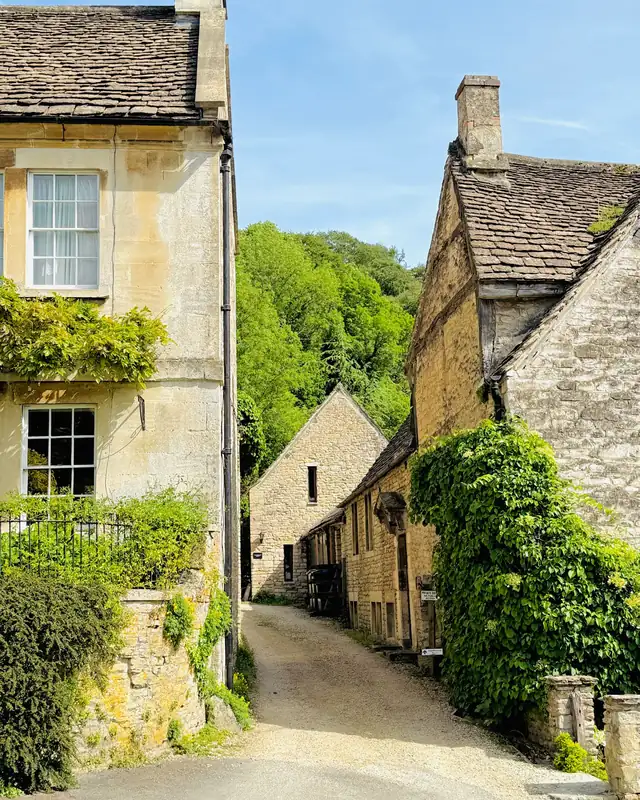
The four sights are the market cross, St Andrew’s Church, the bridge over the By Brook and the view of the cottages along the water. All of them lie on one short street, so you see them in the order you walk down.
The market cross
A roofed medieval market cross stands in the small market place near the church. It is protected as a scheduled monument by Historic England. The weekly market it served had largely ceased by 1840, when the old market house was pulled down.
St Andrew’s Church and the faceless clock
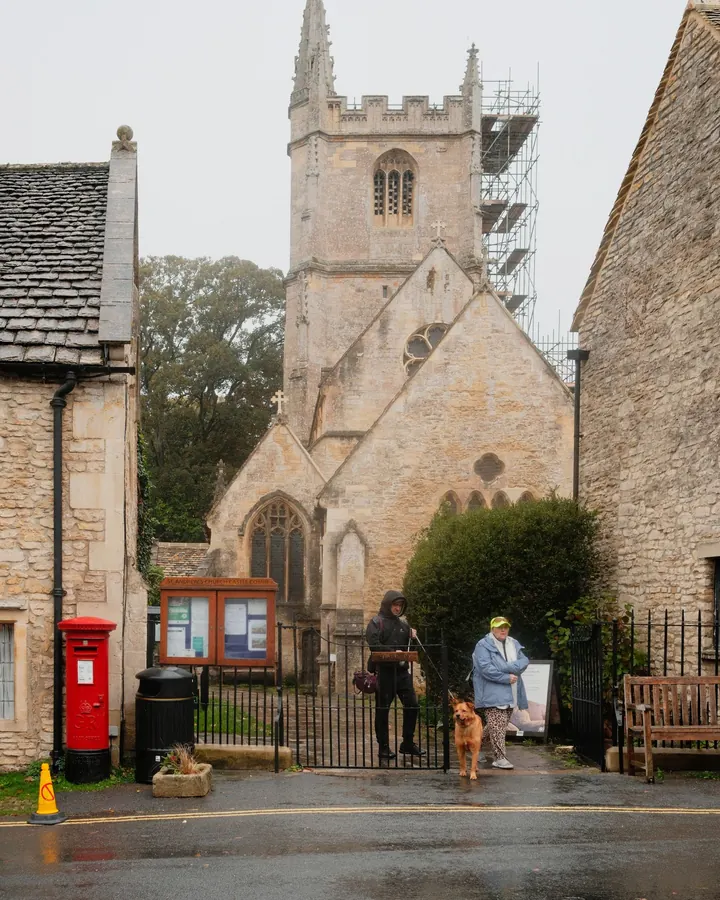
The church is Grade I listed. Work on its 80-foot tower began in 1434, paid for by the wool trade. Most of the building except the tower was taken down and rebuilt in 1850 to 1851.
- The clock: it has no face and stands at the base of the tower. A local blacksmith is believed to have made it in the 1380s. The parish calls it among the most ancient working clocks in the country.
- The knight: a carved tomb shows Sir Walter de Dunstanville, Baron of Castle Combe, who died in 1270.
- Opening: the church is open every day of the year during daylight hours.
The bridge and the By Brook
At the bottom of the street a small stone bridge crosses the By Brook. The view back up the water to the cottages is the one on most postcards. Public toilets are just south of this bridge.
The Manor House
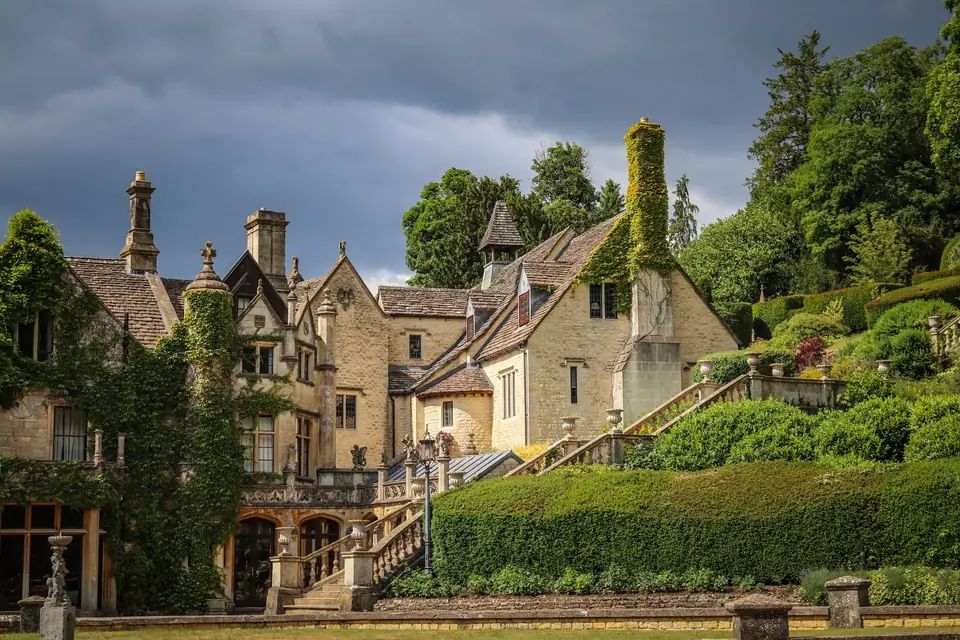
The Manor House, in a 14th-century building, stands in its own grounds at the edge of the village. It became a hotel after 1949, so its gardens are for guests.
How long do you need in Castle Combe?
The village website puts a typical sightseeing visit at 30 to 45 minutes; allow about 90 minutes to see the church and take photographs. Allow two to three hours if you add lunch at one of the two village inns or a walk along the valley.
| Plan | Time in the village |
|---|---|
| Quick look: street, cross, bridge | 30 to 45 minutes |
| With the church and photographs | about 90 minutes |
| With lunch in the village | 2 to 2 hours 30 minutes |
| With a circular walk in the valley | 3 hours or more |
Visit Wiltshire suggests a circular walk through the valley around the village. Keep to the signed footpaths and keep dogs on a lead, because sheep graze the slopes.
How do you get to Castle Combe from London?
By car it is 101 miles and about 2 hours from central London. Without a car, take the train to Chippenham and then a taxi or bus. There is no railway station in the village.
| Way to go | Time and details |
|---|---|
| Car from central London | 101 miles, 2 hours 4 minutes on a weekday morning |
| Car back to London | about 2 hours 12 minutes leaving at 3pm |
| Car from Heathrow | 88 miles, about 1 hour 35 minutes |
| Train to Chippenham | from London Paddington, 1 hour 2 minutes to 1 hour 10 minutes |
| Taxi from Chippenham | 6 miles, about 15 minutes |
| Bus 95 or 95A from Chippenham | about 20 minutes; five a day on weekdays, four on Saturdays |
- Last bus back: it leaves the village at 17:04 on weekdays and 17:30 on Saturdays. Sunday buses run in summer only.
- Last train: the final direct train from Chippenham to Paddington leaves at 23:18 on weekdays.
Our guide to getting from London to the Cotswolds compares every station and bus for the wider area.
By private car with a driver
You can add the village to our private Cotswolds day trip from London. Because it is 56 minutes south of Bibury, adding it means at least two extra hours, from £55 an hour. The driver drops you at the top of the village and waits, so parking is not your problem.
Can you park in Castle Combe?
Yes, in the visitor car park at the entrance to the village, which is pay and display and fills quickly. Visit Wiltshire warns that on bank holidays it is very likely to be full, with no alternative.
- The village centre: it has only 9 parking spaces, and these are becoming residents only. Penalty charge notices may be issued, so do not drive down into the lower village.
- Coaches: they are not allowed into the village centre and use set spaces in the car park.
- If it is full: the village asks visitors to come back at another time rather than park on the lanes.
Tip: arrive before 10am on a weekend or on any sunny day, or come on a weekday outside school holidays.
What can you combine with Castle Combe in one day?
Lacock and Bath are the natural partners: Lacock is 20 minutes away and Bath 35 minutes. We measured each drive from the village on a weekday in November 2026.
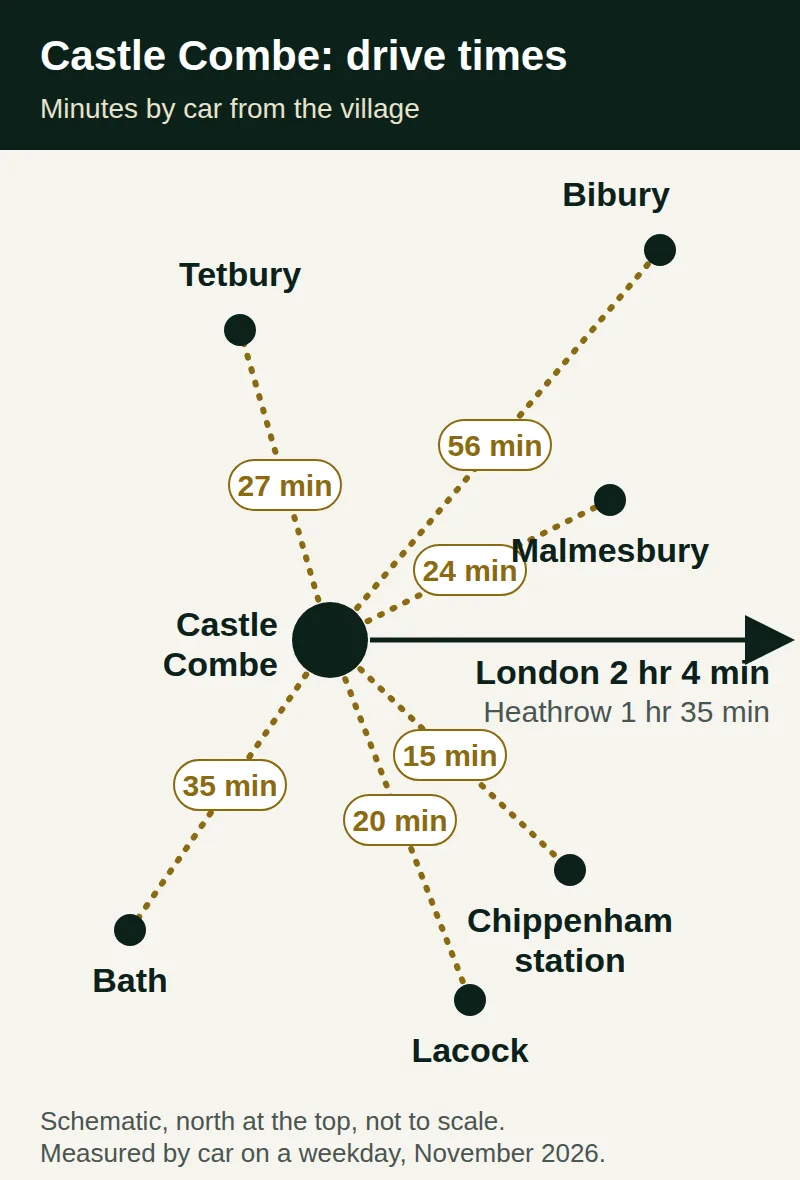
| From Castle Combe to | Drive time and distance |
|---|---|
| Chippenham station | 15 minutes, 6 miles |
| Lacock | 20 minutes, 9 miles |
| Malmesbury | 24 minutes, 11 miles |
| Tetbury | 27 minutes, 13 miles |
| Bath | 35 minutes, 15 miles |
| Bibury | 56 minutes, 31 miles |
| Burford | 1 hour 9 minutes, 48 miles |
| Stonehenge | 1 hour 9 minutes, 34 miles |
- South-west day: Castle Combe in the morning, Lacock for lunch, Bath in the afternoon. Lacock to Bath is a further 37 minutes.
- With Stonehenge: the stones are 1 hour 9 minutes away. Our Stonehenge and Bath day trip can take Castle Combe as a detour.
- With the central Cotswolds: Bibury is the nearest of the famous northern villages, 56 minutes away.
For the northern villages and how they fit together, see our list of the best Cotswolds villages to visit.
When is the best time to visit Castle Combe?
Weekday mornings are the quietest time, in any season. The village is small, so a few coaches or a bank holiday crowd fill the street and the car park.
- Spring and summer: flowers on the cottages and the longest light; the Sunday bus runs only in summer.
- Autumn: the wooded valley turns colour and the crowds thin after the school holidays.
- Winter: the quietest months; the church stays open in daylight, which ends before 4.30pm in December.
FAQ: visiting Castle Combe
Is Castle Combe worth visiting?
Yes, if you want to see an unchanged English stone village. It is small, so 45 to 90 minutes covers it, and it works best paired with Lacock or Bath, 20 and 35 minutes away. It is out of the way for the northern Cotswolds, so on a London day trip it costs at least two extra hours.
Is Castle Combe free to visit?
Yes. It is a living village with no entry charge, and you can walk its streets at any time. St Andrew’s Church is open every day in daylight. The houses are private homes, so they are seen from the lane. Drivers pay at the pay-and-display visitor car park.
Can you visit Castle Combe without a car?
Yes. Take the train from London Paddington to Chippenham, 1 hour 2 minutes to 1 hour 10 minutes, then a taxi of about 15 minutes. Bus 95 or 95A also runs from Chippenham in about 20 minutes, but only five times a day on weekdays and four on Saturdays.
How far is Castle Combe from Bath?
The village is about 15 miles from Bath, roughly 35 minutes by car on a weekday. That makes the two easy to join in one day. Lacock sits between them in time: 20 minutes from the village and a further 37 minutes on to Bath.
What films were made in Castle Combe?
Doctor Dolittle was filmed in and around the village in 1966, for its 1967 release. Later films include Stardust, The Wolf Man and War Horse, and the television drama Doctor Thorne was filmed there in 2016. Visit Wiltshire reminds visitors that it is a lived-in village with about 50 residents in the centre.
How old is the clock in Castle Combe church?
The faceless clock at the base of the tower of St Andrew’s Church is believed to date from the 1380s, made by a local blacksmith. The parish describes it as among the most ancient working clocks in the country. It has no dial and still works.
Sources
Sources: Castle Combe village website, Visit Wiltshire, Wiltshire Community History and Great Western Railway; listing details from Historic England. Drive times measured by us on a weekday in November 2026. Read on 17 November 2026.