
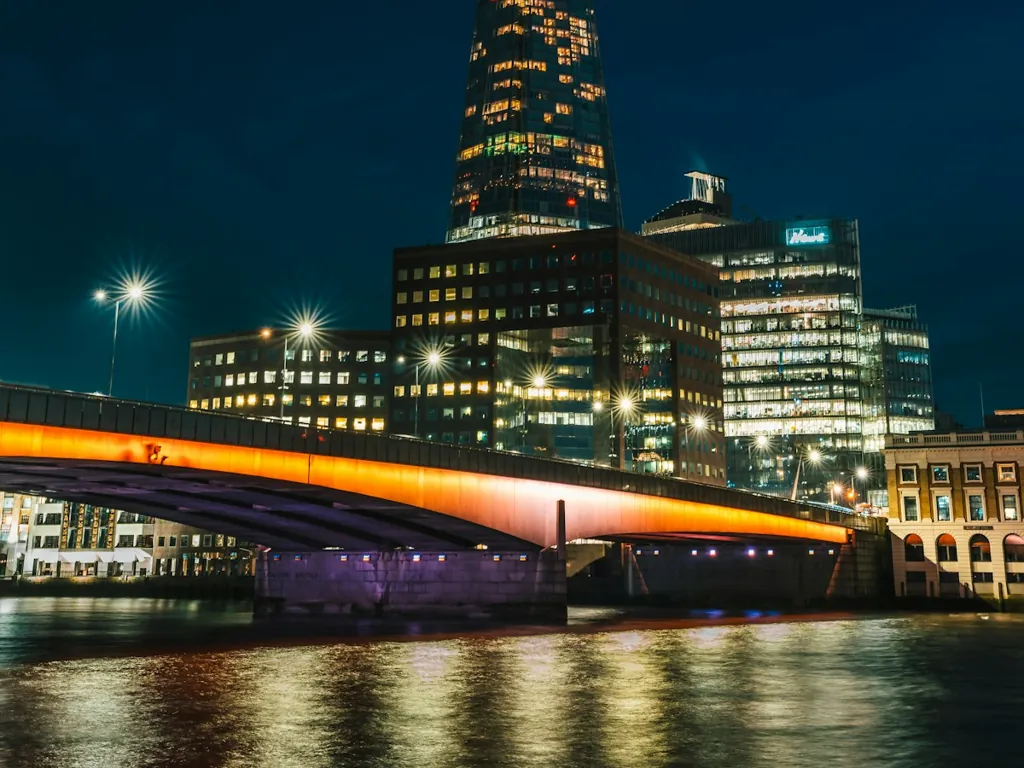
A short, practical guide to London Bridge: how it differs from Tower Bridge, the four bridges that have stood on the site, the facts worth knowing and what to see within a few minutes’ walk. Dates were checked against City Bridge Foundation, Tower Bridge and the London Museum in November 2026.
London Bridge is the plain concrete bridge between the City of London and Southwark, opened in 1973 on a crossing first built by the Romans 2,000 years ago. It is not Tower Bridge, the Victorian bridge with two towers that lifts for ships, about 1 km downstream. Allow two to three hours for the area around it.
London Bridge vs Tower Bridge: the difference
They are two separate bridges in the Pool of London. London Bridge is the plain one upriver; Tower Bridge is the one with two towers that lifts for ships.
- Look: London Bridge is a flat, three-span bridge of concrete faced with polished granite. Tower Bridge has two Gothic stone towers joined by high walkways, designed by Sir Horace Jones and Sir John Wolfe Barry to match the Tower of London.
- Opened: today’s London Bridge on 16 March 1973. Tower Bridge in June 1894.
- Does it open? London Bridge, no. Tower Bridge, yes: its two road sections rise for any registered vessel with a mast of 30 feet or more, free of charge.
- Banks: London Bridge joins the City of London to Southwark. Tower Bridge joins Tower Hamlets, by the Tower of London, to Southwark.
- Inside: London Bridge has nothing to visit. Tower Bridge has a paid exhibition with the glass-floor walkways and the Victorian engine rooms.
- Between them: just over half a mile, under 15 minutes on foot along the south bank.
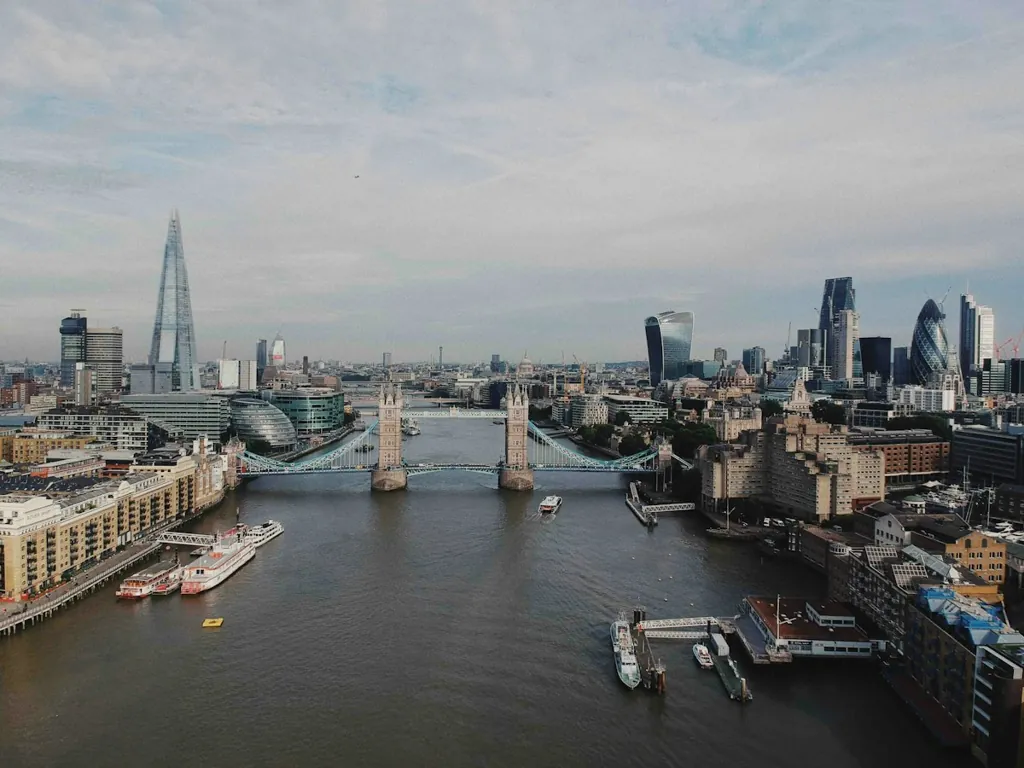
Why people mix them up: Tower Bridge is the one on postcards and in films, and the nursery rhyme makes “London Bridge” the famous name. One popular story says the American who bought the 1831 London Bridge thought he was buying Tower Bridge. Both he and the City official who arranged the sale denied it.
London Bridge history: 2,000 years in four stages
A crossing has stood near this spot since Roman Londinium, around 47–50 AD. Until Putney Bridge opened in 1729, it was the only road crossing of the Thames below Kingston upon Thames; Westminster Bridge followed in 1750.
The Roman and Saxon timber bridges (about 50–1176)
The Romans built the first timber bridge. After they left, the Saxons built a new one by about 1000. In 1014 it was pulled down during a Norwegian-led attack. A storm destroyed it in 1091, and fires and ice damaged it many times.
Old London Bridge (1209–1831)
The first stone bridge was started in 1176 by Peter de Colechurch, a priest, and finished in 1209. It carried houses, shops, inns and a chapel to Thomas Becket, and was the longest inhabited bridge in Europe. From 1305 until the later 1600s the heads of executed traitors were dipped in tar and set on poles above the southern gate. William Wallace was the first, and Thomas More among the later ones. A gap left by a fire in 1633 acted as a firebreak in the Great Fire of 1666, which started near the bridge on Pudding Lane.
John Rennie’s bridge (1831–1968)
By 1800 the old bridge was crowded and blocking the river. Scottish engineer John Rennie designed a wider bridge of five stone arches. He died in 1821, and his son, John Rennie the Younger, built it; it opened on 1 August 1831, and the old one was demolished by 1832. Heavy motor traffic later made it sink unevenly, about an inch every eight years.
Why the 1831 bridge is in Arizona
In 1967 the City of London put Rennie’s bridge up for sale. American businessman Robert P. McCulloch won it on 18 April 1968 with a bid of £1.02 million ($2.46 million). Its 10,276 granite facing blocks were numbered, shipped and rebuilt over a concrete core at Lake Havasu City, where it opened on 10 October 1971.
Today’s London Bridge (1973)
The current bridge was built from 1967 to 1972 on the line of Rennie’s, designed by City Engineer Harold Knox King with Mott, Hay and Anderson and William Holford and Partners. Queen Elizabeth II opened it to traffic on 16 March 1973. It is about 32 metres wide, with three spans on concrete piers set deep in the river clay.
London Bridge facts
- It pays for itself. The bridge is owned by City Bridge Foundation, the working name of Bridge House Estates, a fund that began in 1097. It also maintains Tower, Southwark, Millennium and Blackfriars bridges at no cost to the taxpayer.
- You once paid to cross. Tolls, with rents from the houses and shops, helped pay for repairs to Old London Bridge.
- It helped the river freeze. The old bridge’s 19 narrow arches slowed the river, so in hard winters the Thames above it froze more easily.
- It had a Tudor showpiece. In 1577–1579 the old drawbridge tower was replaced by Nonsuch House, a pair of grand houses with the second classical façade in London.
- The tide was dangerous. The water level on either side of the old bridge could differ by up to 6 feet, and some boatmen who tried to “shoot the bridge” drowned.
- It did partly fall down. Neglected repairs were blamed for collapses of five arches in 1281 and two more in 1437.
- It stands on the oldest crossing. Every bridge has stood close to the Roman crossing. That is why “London Bridge” is also the name of the area and its station on the south bank.
“London Bridge is falling down”: what the rhyme means
The rhyme dates back to at least the 1600s, and nobody knows its exact origin. The most quoted explanations are the bridge’s long record of damage and the endless cost of repairing it. The London Museum notes the bridge never simply fell down, but was brought down many times by other means.
Things to do near London Bridge
Walking times are from the south end of the bridge.
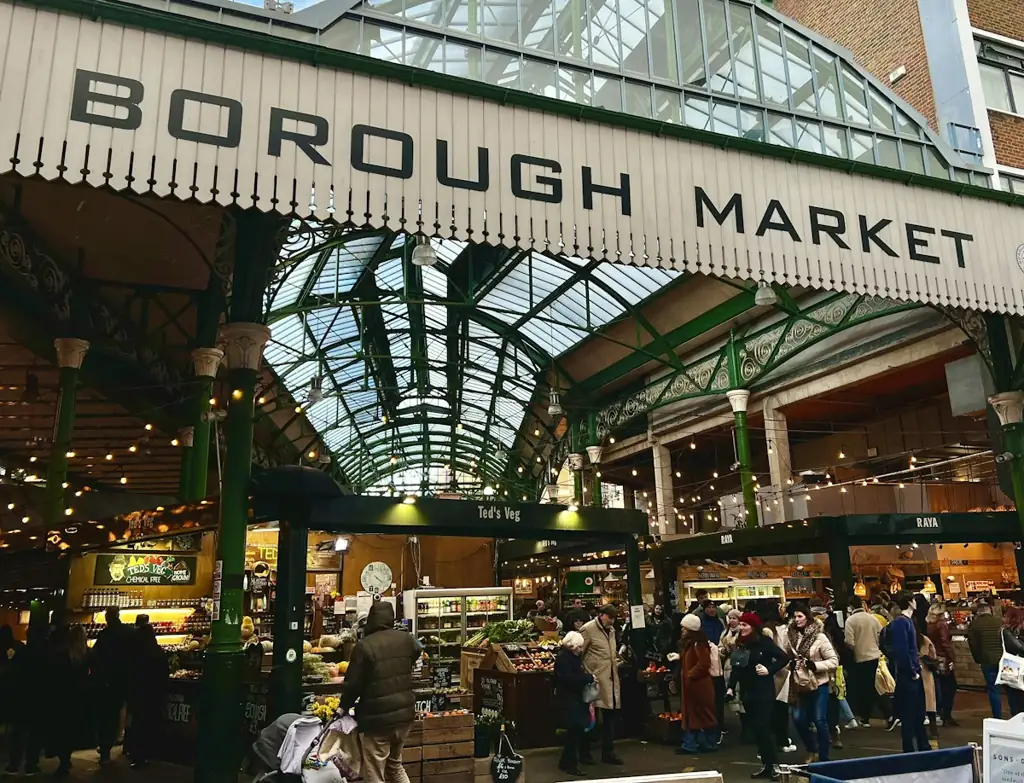
- Borough Market (3 minutes): a food market under Victorian iron roofs, busiest at lunchtime.
- Southwark Cathedral (2 minutes): a 13th-century Gothic church, free to enter, right beside the bridge.
- The Shard (4 minutes): the View from The Shard viewing galleries are on floors 69 and 72, about 244 metres up in a tower 310 metres tall.
- HMS Belfast (8 minutes): a Second World War cruiser moored on the Thames, run by IWM.
- Tower Bridge (under 15 minutes): walk along the river, then inside to the glass-floor walkways.
- The Tower of London (15 minutes, across Tower Bridge or London Bridge): the Crown Jewels and the Yeoman Warders.
- St Magnus the Martyr (about 6 minutes, north bank): the arch under its tower was once the footway onto Old London Bridge.
- Hay’s Galleria (5 minutes, east along the river): a covered former wharf with cafés, on the way to HMS Belfast.
- The Golden Hinde (5 minutes, west along the river): a full-size replica of Francis Drake’s 16th-century galleon in a tiny dock.
- The Monument (about 7 minutes, north bank): the column to the Great Fire, 311 steps to the top.
- Sky Garden (about 12 minutes, north bank): a free public garden at the top of 20 Fenchurch Street, with tickets released in advance. See how to book Sky Garden.
How to visit: a 2–3 hour walk
The area is the reason to come, and this loop takes two to three hours with stops.
- Start at the Monument on the north bank and walk two minutes down to London Bridge.
- Cross London Bridge southbound. Halfway, look downriver: Tower Bridge and HMS Belfast are in the same view.
- Take the steps down to Southwark Cathedral, then into Borough Market for lunch (45–60 minutes).
- Walk east along the river past HMS Belfast to Potters Fields Park, the best spot to photograph Tower Bridge (20 minutes).
- Cross Tower Bridge and finish at the Tower of London, or go up the Tower Bridge exhibition first.
With a car, the easiest drop-off is by Southwark Cathedral or on the north bank by the Monument, with collection by the Tower of London at the end. The drive from Kensington takes about 30–45 minutes in daytime traffic, and from Heathrow about an hour to 90 minutes.
See both bridges with a private driver
Our private London tour by car stops at London Bridge, Tower Bridge and the Tower of London, from £370. For your own route, a chauffeur for four hours costs from £230 in a Mercedes E‑Class: hourly chauffeur hire in London.
Where London Bridge is and how to get there
London Bridge crosses the Thames between the City of London (postcode EC4R) and Southwark (SE1), in central London. London Bridge station, at the south end, gives its name to the area. Arriving at Heathrow, a Heathrow transfer to your hotel takes you straight to the door. A private chauffeur service in London can then link the bridge, your hotel and the rest of your list.
Is London Bridge worth visiting?
The bridge itself is plain. It is worth a stop for three reasons. From the middle you see Tower Bridge and the City; the site has a 2,000-year story; and at either end sit Borough Market and, across the river, the Tower of London. Treat it as the starting point of a two-to-three-hour walk rather than a sight on its own. For more ideas, see our list of things to do in London.
Frequently asked questions about London Bridge
Is London Bridge the same as Tower Bridge?
No. They are different bridges about 1 km apart. The one with two towers that lifts for ships is Tower Bridge (1894); London Bridge (1973) is the flat bridge upriver, by Borough Market.
Which London bridge lifts up?
Tower Bridge. Its two road sections rise for tall ships, and lift times are published on the Tower Bridge website. London Bridge does not open.
When was London Bridge built?
Today’s bridge was built from 1967 to 1972 and opened on 16 March 1973. A crossing has stood on the site since Roman times, and the first stone bridge was finished in 1209.
Why is London Bridge in Arizona?
The bridge in Lake Havasu City is John Rennie’s 1831 London Bridge. It was sold in 1968 to Robert McCulloch for £1.02 million, rebuilt from its numbered granite blocks and opened there in 1971.
What does “London Bridge is falling down” mean?
Its origin is unknown. It is usually linked to the many times the old bridge was damaged by storms, fires, ice and attack, and to the cost of rebuilding it.
How far is London Bridge from Tower Bridge?
Just over half a mile, about 1 km. The walk along the south bank takes under 15 minutes, past HMS Belfast, and from the middle of London Bridge you can see Tower Bridge downriver.
How long do you need around London Bridge?
About two to three hours to see Southwark Cathedral and Borough Market and walk on to Tower Bridge. Allow half a day if you also go inside The Shard or the Tower of London.
Is London Bridge in central London?
Yes. It links the City of London, London’s financial district, with Southwark on the south bank, under 2 miles east of Trafalgar Square and a short walk from St Paul’s Cathedral.
Can you walk across London Bridge?
Yes. It has wide pavements on both sides, takes about five minutes to cross and is free and open at all hours. Steps at the south end lead down to Southwark Cathedral and the riverside path.